> For the complete documentation index, see [llms.txt](https://documentation.astera.com/llms.txt). Markdown versions of documentation pages are available by appending `.md` to page URLs; this page is available as [Markdown](https://documentation.astera.com/setting-up/on-prem/product-architecture.md).
# Product Architecture
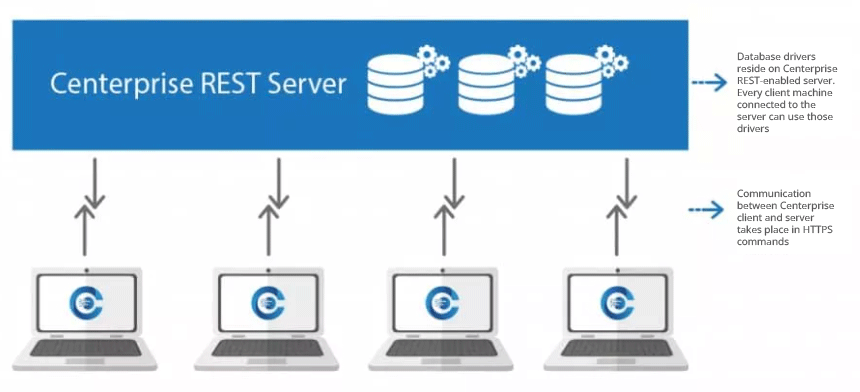
Astera Data Stack is built on a client-server architecture. The client is the part of the application which a user can run locally on their machine, whereas the server performs processing and querying requested by the client. In simple words, the client sends a request to the server, and the server, in turn, responds to the request. Therefore, database drivers are installed only on the Astera Data Stack server. This enables horizontal scaling by adding multiple clients to an existing cluster of servers and eliminating the need to install drivers on every machine.
The Astera client and server applications communicate on REST architecture. REST-compliant systems, often called RESTful systems, are characterized by statelessness and separate concerns of the client and server, which means that the implementation of both can be done independently if each side knows what format of messages to send to the other. The server communicates with the client using HTTPS commands, which are encrypted using a certified key/certificate signed by an authority. This saves the data from being intercepted by an attacker as the plaintext is encrypted as a random string of characters.
---
# Agent Instructions
This documentation is published with GitBook. GitBook is the documentation platform designed so that both humans and AI agents can read, navigate, and reason over technical content effectively. Learn more at gitbook.com.
## Querying This Documentation
If you need additional information that is not directly available in this page, you can query the documentation by asking a question.
Perform an HTTP GET request on the following URL with the `ask` and `goal` query parameters:
```
GET https://documentation.astera.com/setting-up/on-prem/product-architecture.md?ask=&goal=
```
`ask` is the immediate question: it should be specific, self-contained, and written in natural language.
`goal` is what the user is ultimately trying to achieve, the reason they need the answer. Sharing it helps GitBook give you a better, more relevant answer. A goal is most helpful when it describes the outcome the user wants rather than restating the question. For example, with `ask=how do I create an API token`, a goal like `automate deployments from our CI pipeline` lets GitBook tailor the answer to that use case.
The response will contain a direct answer to the question and relevant excerpts and sources from the documentation.
Use this mechanism when the answer is not explicitly present in the current page, you need clarification or additional context, or you want to retrieve related documentation sections.