> For the complete documentation index, see [llms.txt](https://documentation.astera.com/llms.txt). Markdown versions of documentation pages are available by appending `.md` to page URLs; this page is available as [Markdown](https://documentation.astera.com/faqs/installation/how-do-we-maintain-schedules-when-migrating-server-or-upgrading-version.md).
# How do we maintain schedules when migrating server or upgrading version?
How do we maintain existing job schedules and job histories when migrating server to a different machine or upgrading to a different version?
Job schedules, job history and all other information associated with jobs running on a server are maintained in the cluster database. The Build Cluster Database option resets the repository if it already exists, erasing all existing data.
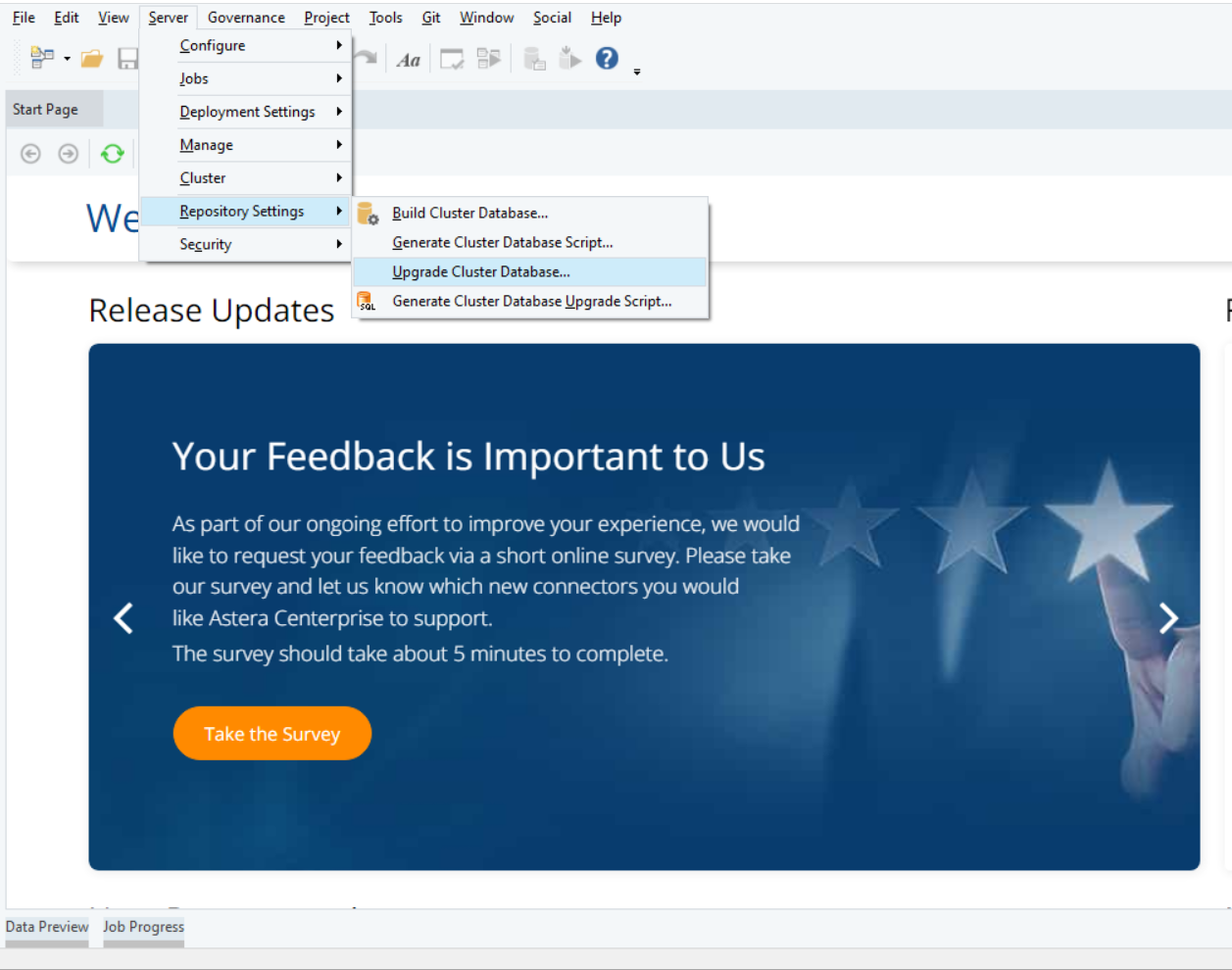
To maintain this data while migrating the server to a different machine or a higher version, choose the option to ‘Upgrade Cluster Database’ in Server > Repository Settings instead of building a new database.
In case you are installing the same version on the different machine, this option does not make any changes to the repository, it only associates your existing repository with the new Server. In case of version upgrade, the option adds new tables and columns to your existing repository, making it compatible with the new version, keeping all your previous data intact. In both cases, migration and upgradation, with the Upgrade Cluster Database option, all the jobs scheduled in the existing server will appear in the new Server after the configuration.
As an added step to safeguard your repository data, create a backup of the cluster database before
Visit [this link](https://documentation.astera.com/setting-up/migrating-from-astera-9-to-astera-10) for step-by-step instructions for migrating from Astera 9 to Astera 10.
---
# Agent Instructions
This documentation is published with GitBook. GitBook is the documentation platform designed so that both humans and AI agents can read, navigate, and reason over technical content effectively. Learn more at gitbook.com.
## Querying This Documentation
If you need additional information that is not directly available in this page, you can query the documentation by asking a question.
Perform an HTTP GET request on the following URL with the `ask` and `goal` query parameters:
```
GET https://documentation.astera.com/faqs/installation/how-do-we-maintain-schedules-when-migrating-server-or-upgrading-version.md?ask=&goal=
```
`ask` is the immediate question: it should be specific, self-contained, and written in natural language.
`goal` is what the user is ultimately trying to achieve, the reason they need the answer. Sharing it helps GitBook give you a better, more relevant answer. A goal is most helpful when it describes the outcome the user wants rather than restating the question. For example, with `ask=how do I create an API token`, a goal like `automate deployments from our CI pipeline` lets GitBook tailor the answer to that use case.
The response will contain a direct answer to the question and relevant excerpts and sources from the documentation.
Use this mechanism when the answer is not explicitly present in the current page, you need clarification or additional context, or you want to retrieve related documentation sections.