> For the complete documentation index, see [llms.txt](https://documentation.astera.com/llms.txt). Markdown versions of documentation pages are available by appending `.md` to page URLs; this page is available as [Markdown](https://documentation.astera.com/report-model/use-cases/line-count.md).
# Line Count
*Line Count* option in a report model in Astera enables users to specify the number of lines over which a data region spans. This feature is useful when transposing data that appears in rows in an unstructured file and convert it into vertical fields (columns) inside a report model.
In this document, we will explore how *Line Count* feature helps with the selection of a data region in Astera.
## Sample Use-Case
In this case, we have unstructured data in a PDF file.
Download the sample PDF file from the following link:
{% file src="/files/TeqtjTnKpRCVCzhtvHnJ" %}

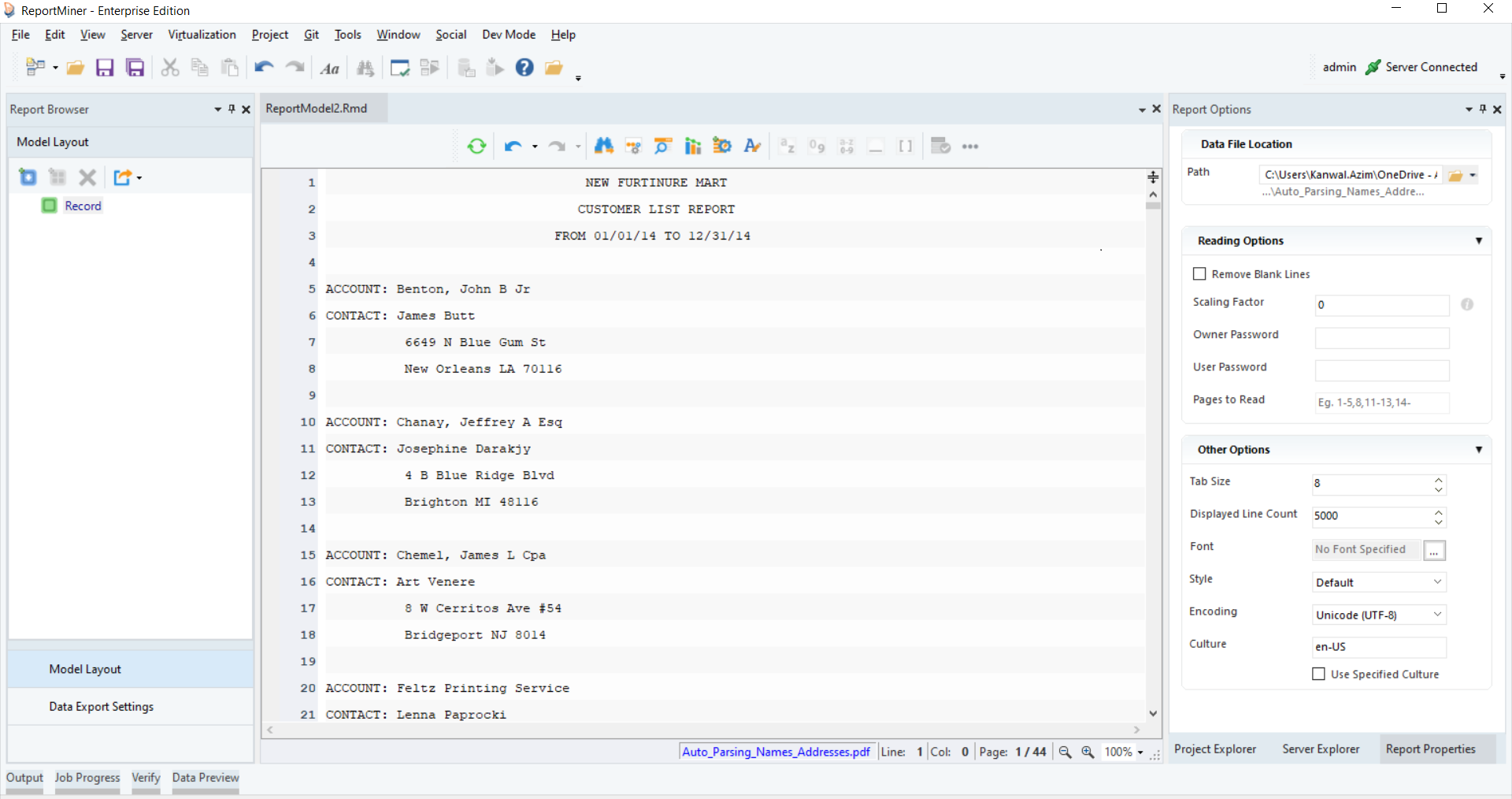
This file contains a customer list report including their account name, contact, and address details.
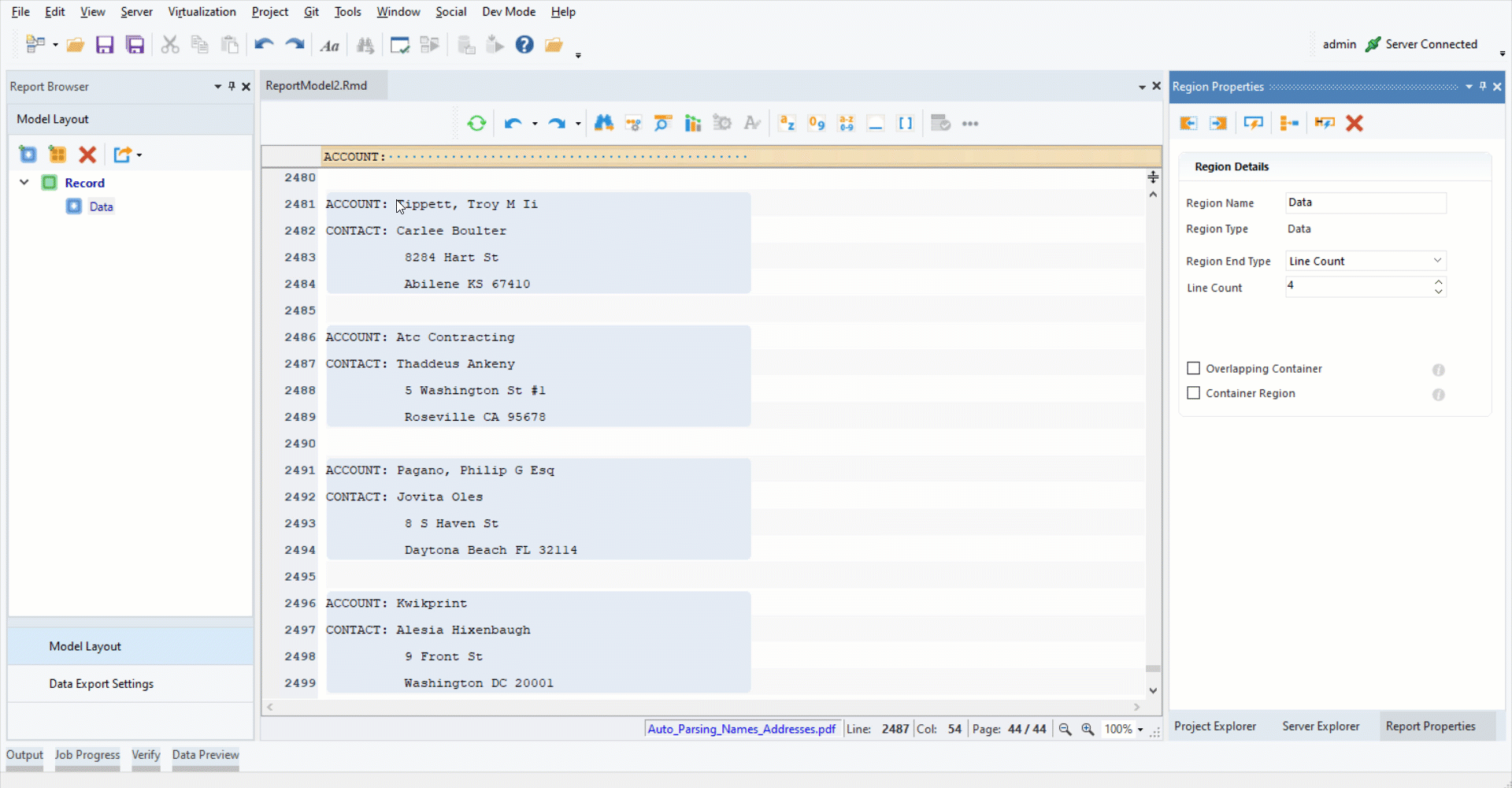
You can see that a single record spans over 4 lines on this PDF file. In order to capture this data and place it into different fields, we will use the *Line Count* feature.
First, let's load this unstructured file onto the report model designer.
1. Go to *File > New > Report Model* and select the source file from your directory.

There are many options available in the Report Options panel to configure how Astera reads the unstructured PDF file such as specifying the scaling factor, font, tab size, and password.
You can read about these options here.
2. Click *OK* and the source file will open on the designer.
Now that we have loaded the source file in Astera, let's create an extraction template.
## Creating a Report Model
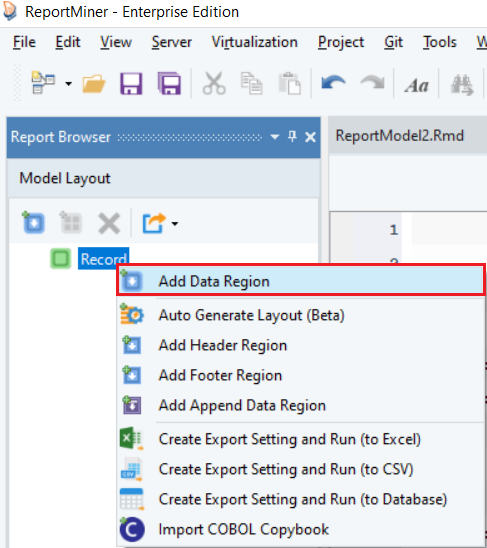
1\. Right-click on the *Record* node under the Model layout panel and select *Add Data Region* from the context menu.
A pattern-matching bar and Region Properties panel will appear and a *Data* node will be added under the *Record* node in the Model Layout panel.
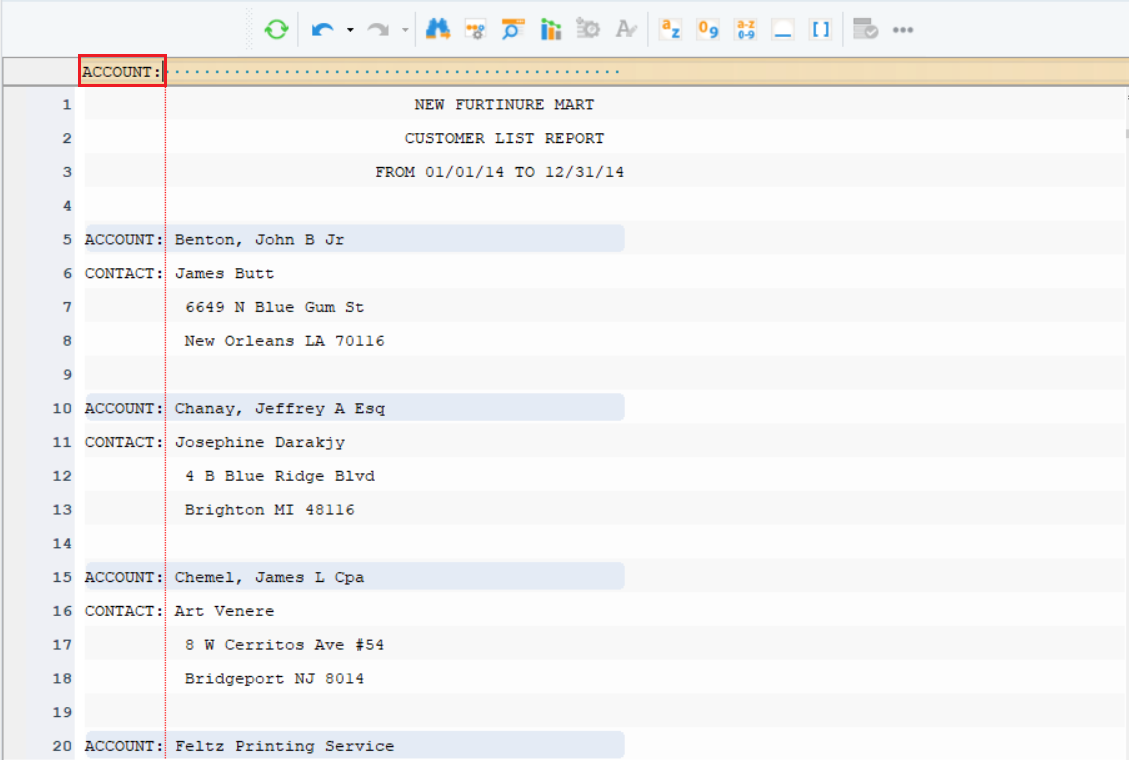
2\. Specify a pattern with which Astera can match your source file to capture the desired data. You can use an alphabet, character, number, word, or a wild card or any combination of these to define your pattern.
In this case, write "ACCOUNT" in the pattern-matching bar as shown below.
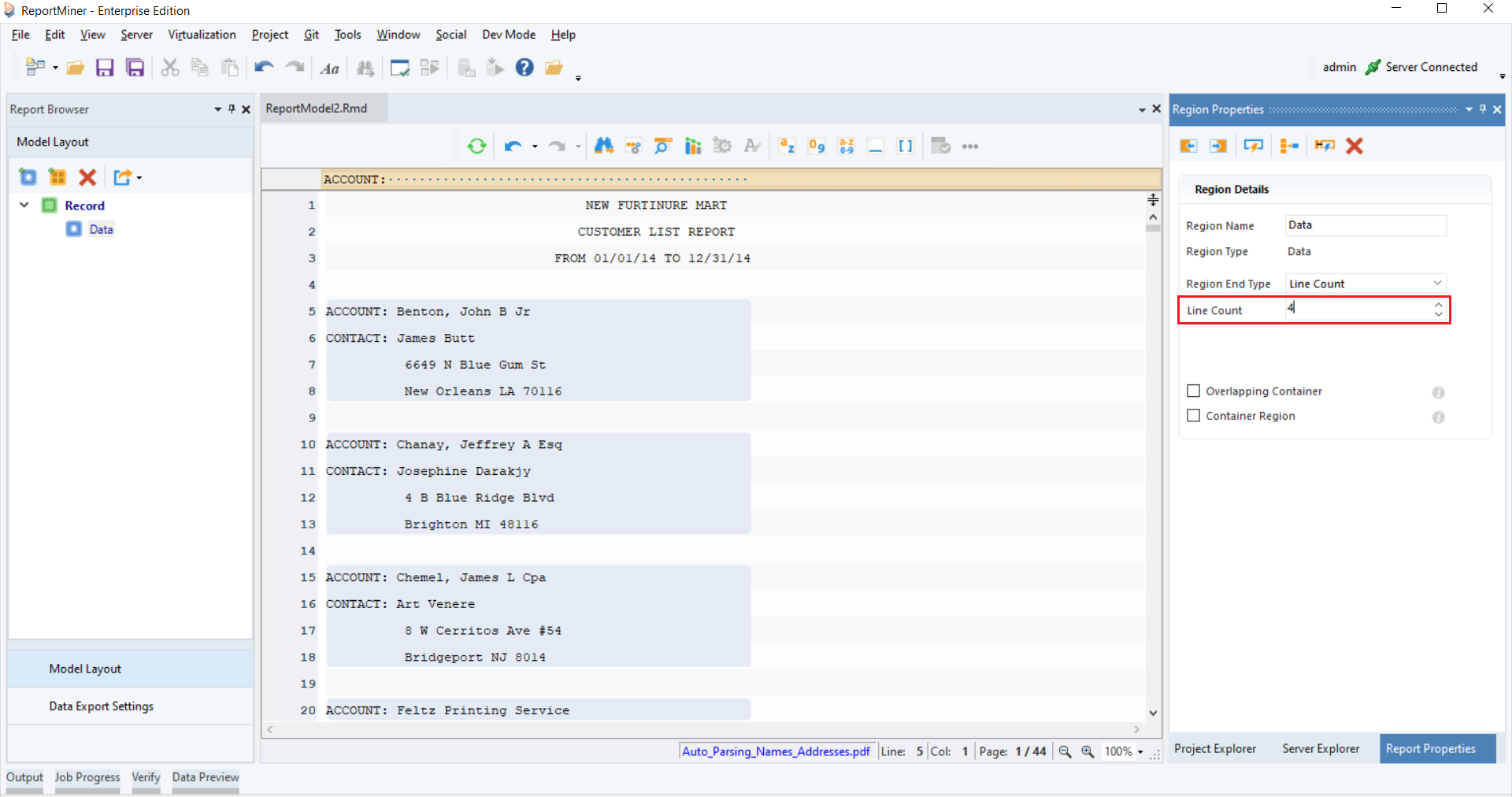
You can see that only one field information is captured through matching pattern. In order to capture the data spanning over 4 lines, we must increase the *Line Count* to 4.
3\. Increase the *Line Count* value to 4 from the Region Properties panel.
Each data region block contains information of a single record. Let's create data fields.
4\. Highlight the data region after "ACCOUNT:", right-click on it and select *Add Data Field* from the context menu. Rename it to *Account*.
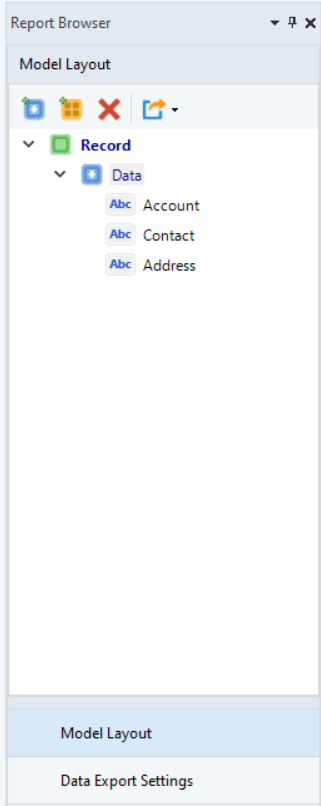
5\. Repeat the process to create more data fields. You can see the layout of the extraction template in the Model Layout panel.
6\. You can preview data by clicking on the *Preview Data* icon placed in the toolbar at the top of the designer window.
A *Data Preview* window will open displaying a preview of the extracted data.

This concludes using the *Line Count* option while building an extraction template in Astera.
---
# Agent Instructions
This documentation is published with GitBook. GitBook is the documentation platform designed so that both humans and AI agents can read, navigate, and reason over technical content effectively. Learn more at gitbook.com.
## Querying This Documentation
If you need additional information that is not directly available in this page, you can query the documentation by asking a question.
Perform an HTTP GET request on the following URL with the `ask` and `goal` query parameters:
```
GET https://documentation.astera.com/report-model/use-cases/line-count.md?ask=&goal=
```
`ask` is the immediate question: it should be specific, self-contained, and written in natural language.
`goal` is what the user is ultimately trying to achieve, the reason they need the answer. Sharing it helps GitBook give you a better, more relevant answer. A goal is most helpful when it describes the outcome the user wants rather than restating the question. For example, with `ask=how do I create an API token`, a goal like `automate deployments from our CI pipeline` lets GitBook tailor the answer to that use case.
The response will contain a direct answer to the question and relevant excerpts and sources from the documentation.
Use this mechanism when the answer is not explicitly present in the current page, you need clarification or additional context, or you want to retrieve related documentation sections.